INSIGHT / RESEARCH
What I Found When I Started Looking Across Organisations
Different organisations. Different countries. Different decades. Why did some of the same questions keep returning?
By Dr Simon Le Clerc MStJ CF
September 2026
I didn't set out to build a large research repository.
And I certainly didn't begin with a theory I was trying to prove.
I began with something much simpler.
There were things I had seen in organisations that I couldn't quite explain.
Different people. Different circumstances. Different industries. Yet every so often I would find myself sitting in a meeting, reading a report or looking back at a decision and recognising something I'd encountered somewhere completely different.
Sometimes it was the confidence with which something was being presented.
Sometimes important information existed but hadn't quite reached the people making the decision.
Sometimes an assumption appeared to have become accepted without anybody being entirely sure where it had originated.
Sometimes everybody was asking perfectly sensible questions, but I found myself wondering whether they were actually the questions that mattered.
None of those observations seemed particularly remarkable on their own.
What interested me was that I kept encountering variations of them in organisations that otherwise had very little in common.
So I started looking more closely.
Initially, that meant individual cases.
Public inquiries. Investigations. Regulatory findings. Independent reviews. Parliamentary material. Technical reports. Judicial findings. Organisational debriefs.
Cases where consequential decisions had ended in corporate collapse, public scandal, operational failure or tragedy.
But I also became interested in the opposite.
What happened when people adapted well?
When circumstances changed dramatically and somebody recognised that their previous understanding was no longer sufficient?
When uncertainty remained considerable, but judgement was nevertheless exercised well?
The more I looked, the larger the investigation became.
Calling them "cases" probably understates the work
What began with individual cases gradually became something much larger.
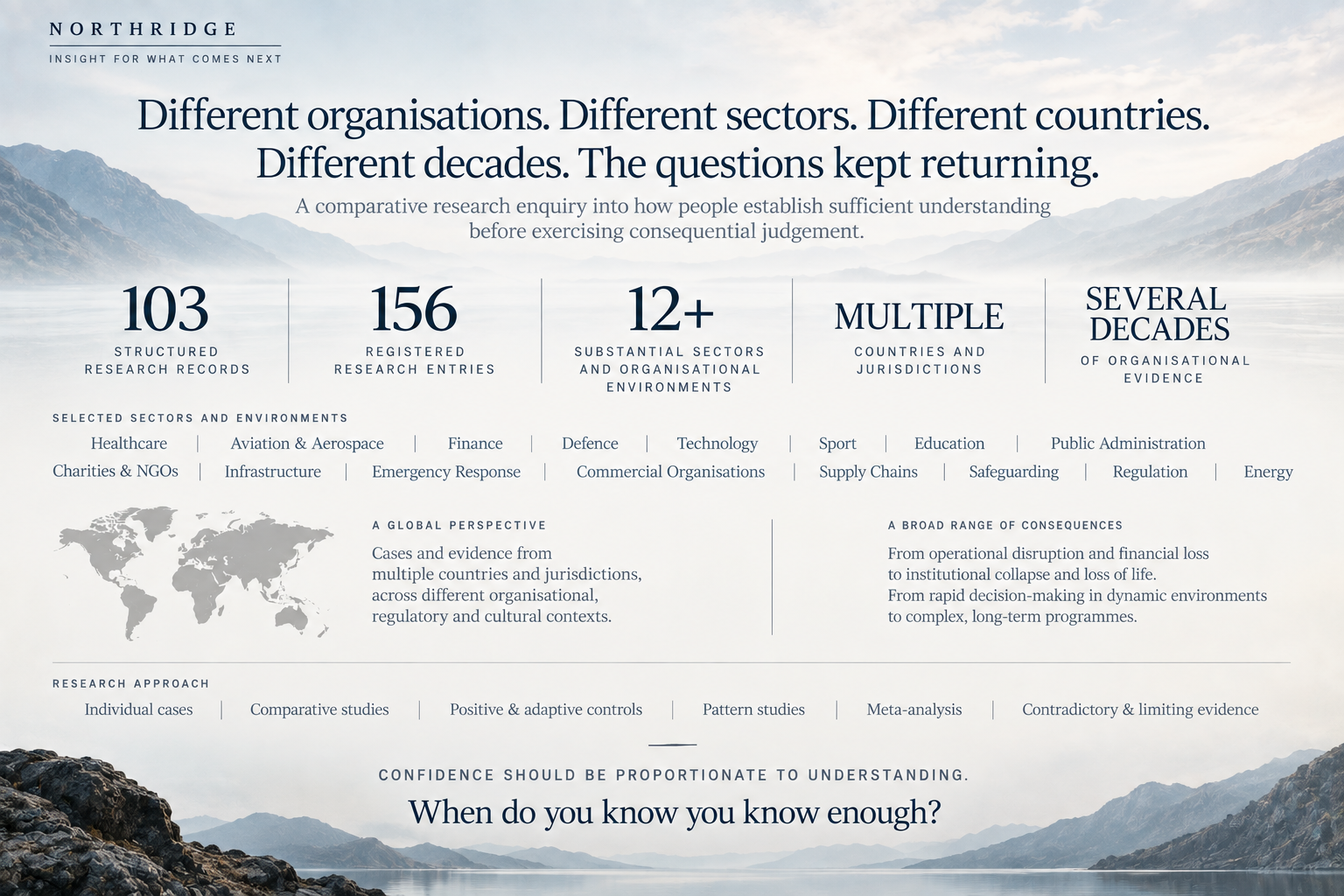
The research repository that eventually developed now contains 103 structured research records, within a wider register of 156 entries encompassing individual cases, comparative studies, positive and adaptive controls, pattern studies, meta-analyses and thematic evidence work.
It reaches across at least a dozen substantial organisational sectors and environments, different countries and jurisdictions, and several decades of organisational evidence.
But even those numbers don't really describe the enquiry.
For many cases, an official inquiry, investigation or review was only the starting point.
From there I followed the available evidence into regulatory findings, technical reports, parliamentary material, organisational responses, independent reviews and other publicly available records.
And then I went back through that material asking a different set of questions.
I wasn't simply trying to establish what happened.
I wanted to understand, as far as the available evidence would allow, what the people carrying responsibility knew at the time; what they could reasonably have known; what information existed elsewhere; what assumptions were being made; what remained uncertain; and how confidence to proceed had formed.
Sometimes the detail that interested me most wasn't in the eventual conclusion at all.
It was buried much earlier.
Somebody had raised a concern.
An assumption had changed.
Information existed in one part of a system but hadn't reached another.
A formal assurance had been accepted without establishing quite what it actually demonstrated.
A weak signal had appeared once, then again, but each occurrence seemed insufficient on its own to change course.
Those details mattered because I wasn't simply trying to explain the outcome.
I was trying to understand the judgement before the outcome was known.
Then I moved to another organisation.
Another sector.
Another country.
Sometimes another decade.
And asked the questions again.
Over time, individual cases became comparative studies. Apparent patterns were tested elsewhere. Positive and adaptive cases were considered alongside failures. Cases that complicated an emerging idea became as important as those that appeared to support it.
The purpose wasn't to accumulate examples.
It was to find out which observations survived when almost everything else changed.
The outcome doesn't necessarily tell us whether the judgement was sound
There was an obvious difficulty in doing this.
I already knew what happened next.
The people making the original judgement didn't.
So, as far as the evidence allowed, I tried to distinguish what subsequent inquiries and investigations established from what was reasonably knowable at the time — and both of those from what I might infer only because I already knew the ending.
That distinction became increasingly important.
It is easy to look at a disastrous outcome and conclude that the original judgement must have been a bad one.
It is equally easy to look at success and assume the judgement behind it must have been good.
Neither is necessarily true.
A reasonable judgement can still produce a poor outcome.
Circumstances can change. Something genuinely unforeseeable can happen. Information that could not reasonably have been available can subsequently become important.
Equally, somebody can make a poorly founded decision and get lucky.
So I became less interested in asking simply:
What went wrong?
And more interested in asking:
Given what could reasonably have been understood at the time, was the confidence to act justified?
And, where it wasn't:
What might have improved it?
That turned out to be a rather different enquiry.
Then the organisations became very different indeed
As the repository grew, the organisations and circumstances became increasingly difficult to compare on the surface.
I found myself moving between healthcare and aviation, finance and defence, sport and safeguarding, technology and public administration, education and charities, infrastructure, emergency response, commercial organisations and complex supply chains.
The countries changed too.
So did the decades, regulatory environments, organisational structures and consequences.
Some cases involved catastrophic loss of life. Others involved corporate collapse, financial loss, operational disruption, public scandal or profound failures of trust.
And some were not failures at all.
Post Office Horizon · Boeing 737 MAX · Mid Staffordshire · Barings Bank · USA Gymnastics
Nimrod XV230 · Brumadinho · Flint · Oxfam Haiti · UK exams-grading algorithm
CrowdStrike · KFC supply-chain disruption · Apollo 13 · Chilean Mine Rescue
They weren't interesting because the organisations were similar.
They became interesting because they weren't.
Yet when I looked beneath the surface — at what people understood, what evidence they relied upon, what somebody else already knew, what remained uncertain and how confidence to act formed — some of the same questions kept returning.
That was the point at which I began to wonder whether I was looking at something more persistent than a collection of individual organisational failures.
Why do the lessons keep returning?
There was another difficulty I couldn't quite ignore.
Many of these organisations had already learnt lessons.
Their sectors had conducted inquiries, investigations, after-action reviews and improvement programmes before.
Recommendations had been made. Policies had changed. Processes had been redesigned. Training had been introduced.
Yet years later, sometimes in an entirely different organisation or country, something uncomfortably familiar appeared again.
Not the same event.
Not necessarily the same cause.
But familiar questions about what people understood, what information reached them, which assumptions had gone untested, how concerns were interpreted and why confidence to proceed had formed.
That made it increasingly difficult to believe that the answer was simply to "learn the lessons" one more time.
If recognisable patterns can reappear after decades of inquiries, reviews and recommendations, perhaps there is still something more fundamental that we need to understand about the way people and organisations reach consequential judgements.
Somewhere during that work, my interest changed
I was still fascinated by why consequential decisions had gone wrong.
But increasingly I found myself thinking about a different moment.
Not the inquiry afterwards.
Not the investigation.
Not the point at which everyone already knew how events had unfolded.
The moment before.
What would I have wanted to ask if I'd been in the room before the decision was made?
Not with hindsight.
Not knowing how events would eventually unfold.
Just sitting alongside the people carrying the responsibility, with the information that was reasonably available to them at the time.
What would I want to understand before I became comfortable saying:
Yes. We know enough to proceed.
That question gradually became as important to me as the research itself.
Because there is only so much value in becoming better at explaining consequential decisions after we know how they ended.
I became much more interested in whether the recurring questions within the evidence could help people before the outcome was known.
Could we become better at establishing what somebody really needs to understand before making a particular judgement?
Could we test whether the evidence they are relying upon genuinely supports that understanding?
Could we make important uncertainty more visible rather than unconsciously converting it into confidence?
Could we recognise when circumstances have changed enough that yesterday's judgement deserves to be questioned again?
And could we do all of that proportionately — recognising that a reversible operational decision and an irreversible decision affecting lives, livelihoods or substantial capital plainly do not require the same depth of enquiry?
I think we can.
Consequential judgement doesn't only happen at the top
The more I studied consequential judgement, the harder it became to think of it as something that happens only at the top of an organisation.
A Board may approve a strategy.
But somebody else decides how to interpret it.
A manager decides whether a recurring workaround has become a genuine problem.
A project leader decides whether something is actually ready to go live.
A professional decides whether the evidence in front of them is sufficient to act.
Somebody decides whether an emerging concern is significant enough to escalate.
A founder decides whether to commit another portion of limited capital.
And throughout an organisation, people decide whether circumstances have changed enough to revisit yesterday's judgement.
The scale of consequence changes.
So should the depth of understanding reasonably required.
But the responsibility to establish sufficient understanding before acting doesn't disappear.
Much of the richest publicly available evidence comes from major organisations and significant events for a simple reason: serious failures generate inquiries, investigations and detailed records.
That inevitably means the repository contains more evidence about highly consequential and formally investigated events than it does about the thousands of quieter judgements made every day inside smaller organisations and management teams.
But the underlying question plainly isn't confined to organisations large enough to generate an inquiry.
Whether somebody is committing billions of pounds, changing a clinical service, launching a product, managing a team, allocating scarce resources or deciding whether an emerging problem needs attention, there eventually comes a point at which further enquiry has to stop and judgement has to begin.
Which brings me back to the question that increasingly sits beneath all of this:
Do we understand enough to act?
I've now spent a considerable amount of time studying consequential decisions after their outcomes were known.
But the moment that increasingly interests me isn't the one afterwards.
It's the one before.
The meeting is still taking place.
The evidence is on the table.
Different people know different things.
Some assumptions are visible. Others aren't.
There are things nobody yet knows.
Time, money, reputation and other pressures may be influencing the conversation.
Confidence is beginning to form.
And eventually somebody has to decide.
Do we understand enough to act?
After years spent studying what happens next, that's the room that interests me now.
Because beneath almost every case I've studied sits a question that has become increasingly difficult for me to leave alone.